
Published March 30, 2026
By Ivy Knight
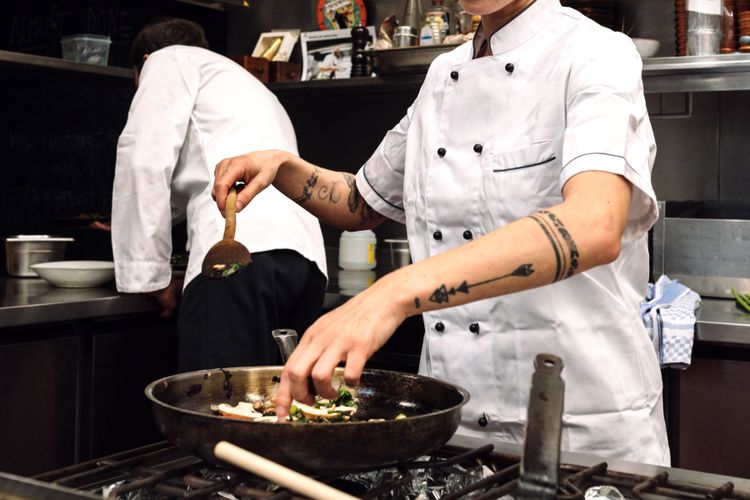
When I was coming up as a line cook, I knew the all-male crews I worked with didn’t hate me. I just didn’t matter as much to them as they did to each other. This created a barrier I came up against constantly. That is not an experience unique to me, and it certainly isn’t confined to kitchens.
In her 1911 book The Man-Made World, sociologist Charlotte Perkins Gilman argued that society had been built around male experience to the point where men didn’t even notice it — it was simply considered “normal.” She coined the word “androcentrism,” a designation that explains men’s deep love and esteem for one another but has nothing to do with sexuality. It differs from misogyny in that it doesn’t require active hatred of women. A man can like women just fine and still be androcentric.
Androcentric men genuinely believe their friendships with other men carry more weight and substance than their bonds with the women in their lives. Women are simply less central and less important by default.
This helps explain how it can feel to be a woman in the restaurant industry.
At a time when it feels like so much of society is regressing, restaurants might not be the first place you’d look for forward-thinking societal change. Many in the industry still defend the unpaid labor that sustains so many fine-dining business models. Plenty defend the same tired brigade system and see no problem with male-only lineups at culinary festivals and events. For how much longer will that continue?
Speaking out about harassment, questioning unpaid labor, and demanding work-life balance were virtually unheard of in food and beverage until about a decade ago. Women have often led that charge. In the recent Noma reckoning, posts by former test kitchen head Jason Ignacio White went viral, but writer Lisa Lind Dunbar had been posting about the allegedly toxic working conditions as early as 2022, and continued to do so for years. In 2018, pastry chef Lisa Donovan won a James Beard Award for her Food & Wine essay on sexual harassment in restaurant kitchens. In 2017, a group of former Spotted Pig employees, including whistleblower Trish Nelson, came forward with allegations of a hostile, dangerous work environment fomented by the restaurant’s owners.
Women are increasingly visible, more outspoken, and expanding into less traditional culinary career paths. Now, in the wake of #MeToo and five years out from a pandemic lockdown that rocked the industry to its core, things feel different — more hopeful, but no less urgent.
Here’s what 13 women are saying about the state of the restaurant industry right now.
Interviews have been edited for length and clarity.
Jackie Carnesi, chef
“There are more women entering the field, and the visibility is greater than it’s ever been. In food media and accolades, there’s more of an effort to highlight us, but the door isn’t yet open far enough. Toxic work environments still exist. The boys’ club still exists. Microaggressions and locker room behaviors still exist. Put more women in leadership roles, show how inclusive and professional work environments can be, and more women will enter the industry as line cooks.”
Namrata Hegde, chef, food stylist, and writer of a viral essay about interning at Noma
“I would feel a lot safer from sexual harassment, but just because a woman is in charge doesn’t mean a kitchen is less toxic — although it is probably less violent. Getting out of restaurants was very helpful for me. I can’t say that I’m completely healed from the trauma, and I do need to go to therapy because there are still a lot of things that trigger me.
I never want to be in a position where someone can hold my livelihood over me. My reputation and referrals are carrying me forward. My self-confidence is getting better by the day. It takes a village to build a life, and without the people who helped me out, I wouldn’t be here.”
Stacey Oldenburger, pastry chef, Langdon Hall
“I’ve been in the industry for three years, and I’ve found that I’m treated equally by everyone. All of my head chefs have been male, and the majority of my pastry chefs are female. I’ve never had a problem. I love the high pressure and intensity of a busy service — the whole mood changes when everyone is so focused. In pastry, it’s usually a lot calmer, but it’s still a very demanding job.”
Kerry Diamond, publisher and podcaster, Cherry Bombe
“When I talk to younger people in the industry there’s a sense of ‘It’s so bro-y,’ or ‘Men run this world.’ If anyone thinks it’s bro-y today, just look back a decade. Almost all of Danny Meyer’s restaurants now have female executive chefs. Chef Gabriela Cámara’s Cantina Contramar will open at the Fontainebleau in Vegas this month. It’s a major restaurant project with millions of dollars behind it, fronted by women. The women of King — Clare de Boer, Jess Shadbolt, and Annie Shi — have gone from being a novelty in New York (“Three women open a restaurant!”) to respected pros with five well-regarded projects among them. They’re also all moms, so they’re role models for young people who want families one day.
There are so many women crushing it.
— Kerry Diamond
I’m more concerned about the fate of the industry than I am about the fate of women in this industry. There are so many women crushing it. They want a different industry and a different world. They’re the new men in terms of volume — but not in terms of mindset.”
Laila Adarkar, line cook, Chez Panisse
“I’m still pretty green, but it feels good to be a line cook right now. Working and staging, I have found that female-led kitchens tend to be less egocentric and more organized, and have clearer communication than those led by men. I’ve noticed that when I work under female chefs, the assumed ceiling is higher. They’ll put more faith in you.”
Karen Kim, chef, Tono by Akira Back
“I started cooking at school at 15 years old. It used to be that people would be surprised to see a female chef in the kitchen and make comments about it. That happens much less now. I have deep connections with other female chefs. We have the same challenges, and we understand each other.”
Amethyst Ganaway, chef and writer
“There are more opportunities now, and I’ve seen huge growth in entrepreneurship. I get to explore food in a million different ways, I don’t have to clock in for someone else. In a restaurant, you’ve got to work your way up, and head chef is the highest you can reach.
During COVID-19, I was able to seek opportunities outside of restaurants. I write for the New York Times, Eater, and Food & Wine. I create events with my company Water Whippin’. I do community work and historical educational work with the South Carolina State Museum. I wrote my first book. I never knew there were these options when I was a line cook.”
Lisa Lind Dunbar, writer and former server
“Having women in a fine-dining kitchen doesn’t magically make it feminist. Even though women may feel more empowered to speak, the environment of the restaurant industry is still shaped by traditions and expectations that were not built with them in mind.
Having women in a fine-dining kitchen doesn’t magically make it feminist.
— Lisa Lind Dunbar
BIPOC women and people who do not fall within the cisgender binary spectrum will experience this oppression even further. As I wrote in an essay for Atlas, ‘The restaurant industry, in its construction, is dominated by patriarchal values, set in a bulletproof, almost militant, hierarchical system, that serves an exclusive club of men, with the rest of us as collateral damage.’”
Emma Cardarelli, chef and owner, Nora Gray, Elena, and Gia
“In this generation of kids, there’s more equality in their social lives than there was in mine. My daughter is six, and everybody hangs out together. There’s a spectrum of gender for young people I meet. This is their reality; it’s not an adjustment for them as it is for older generations. It’s so much less important to them.
I was raised as such a feminist, and I can’t believe I’m still talking about it in terms of women being left out of things. I think for the next generations, it’s going to be very different.”
Robynne Maii, chef and owner, Fête and Mille Fête
“Being a woman in this industry is infinitely better now than when I started in 1996. “Violent” is a really strong word, but working in my first restaurant in New York City, it did feel violent on a daily basis.
We’re less violent for sure.
— Robynne Maii
Women-led restaurants are friendlier places to work in. Of course there are exceptions, but traditionally we’re so much more collaborative and less ego-driven. We’re less violent for sure. I had dreams of an all-female kitchen, but in the end, who cares about gender? We’re just trying to fill our team with good, kind people.”
Yeaen Jun, head pastry chef, Harbour 60
“I’m a Korean who grew up in Mozambique — a developing country where women’s rights weren’t at the forefront. As a woman and a minority, it was a constant struggle to be seen and heard. Coming to Canada was a big change. It’s very progressive here, and I’ve worked with lots of talented women. The culture is changing and I’m very excited for the future of restaurants.
While I’m still young, I want to meet talented people, learn as much as I can, and create a support network. There’s an understanding between women in this industry. We just know. We look out for each other.”
Elisabeth Prueitt, co-founder, Tartine
“There’s been a clarifying effect for women in food since the pandemic started. The women who stayed or entered the field seem more self-directed, and more explicit about boundaries. They’re more willing to speak truthfully about conditions, and less apologetic about the value of their work. There’s less tolerance for the old grind-at-all-costs model, and there is leadership that looks different from the traditional, hierarchical kitchen culture I came up in.”
Martine Bauer, chef and owner, Bar Allegro, Bakery Pompette, and Bar Pompette
“I have been in this industry for 22 years. Women are not just visible now; we are leading and shaping the culture. There’s a lot more to do, and we still need more women, but I think it’s moving in a good direction.
My daughter sees me as an entrepreneur, building a brand. It changes what feels possible for her and for all women. If her generation can see us being powerful, they will be stronger.”